On this page
AT A GLANCE
An AI system for workplace guidance and incident documentation, combining protocol-grounded retrieval with guided conversational workflows.
My contribution
I led the applied-AI architecture and prototyping across retrieval and RAG, model experimentation, guided conversation design, evaluation, and serving alternatives.
Key facts
Key engineering decisions
Keep protocols outside model weights
Use hybrid retrieval at question time so sources remain reviewable, updateable, and distinct from conversational behavior.
Use guided conversation for incident intake
Map the required facts into structured case data and make completion criteria explicit instead of starting with a static long form.
Match small chunks, return parent context
Use precise child chunks for retrieval while giving the model the surrounding passage needed to interpret procedural guidance.
Keep serving replaceable
Explore self-hosted and managed model paths without replacing the retrieval workflow or assuming a published adapter served every variant.
Project evolution
- Protocol-grounded guidance
- Guided incident reporting
- Hybrid retrieval
- Model experimentation
- Serving alternatives
- Retrieval snapshots
Careful answers to sensitive questions
Questions about workplace violence rarely arrive as clean search queries. A person may describe an incomplete situation, use unfamiliar terminology, or be unsure which procedure applies. Neurona explored how to offer clear, empathetic information in Spanish while grounding answers in curated prevention protocols.
The product also included a guided reporting channel. Instead of presenting a long form at the start, the conversation collected what happened, where it happened, and who was involved. As the required checklist became complete, the system created a structured record and suggested the next escalation path.
The boundary mattered as much as the automation: the assistant could organize information and explain a configured protocol, but it did not determine guilt or replace HR, legal, psychological, emergency, or law-enforcement professionals.
My contribution
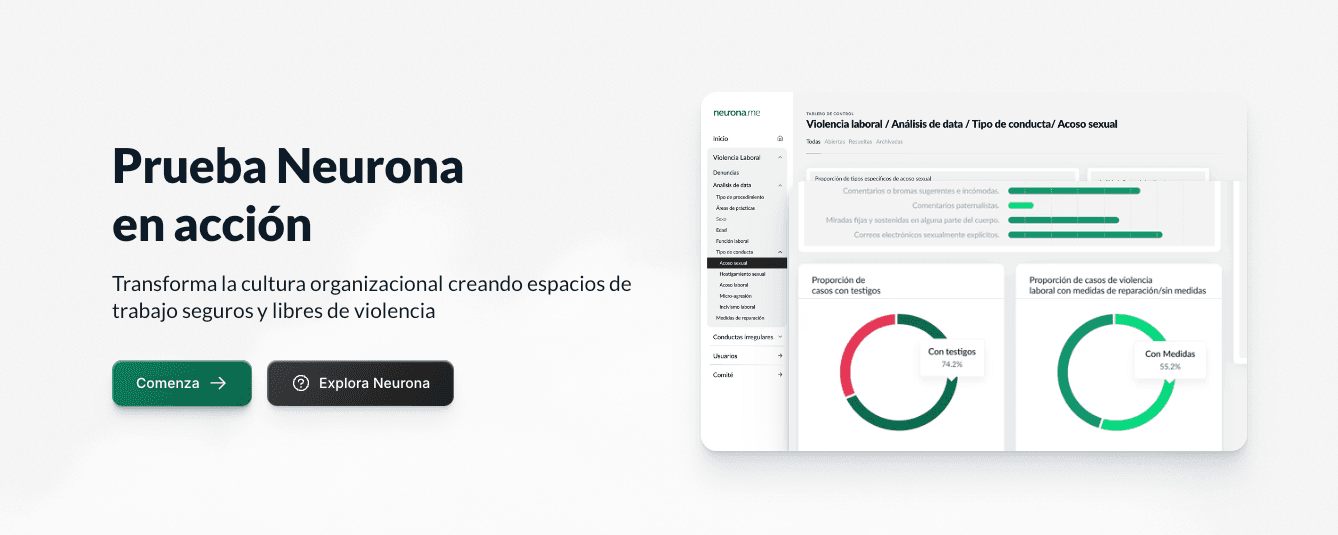
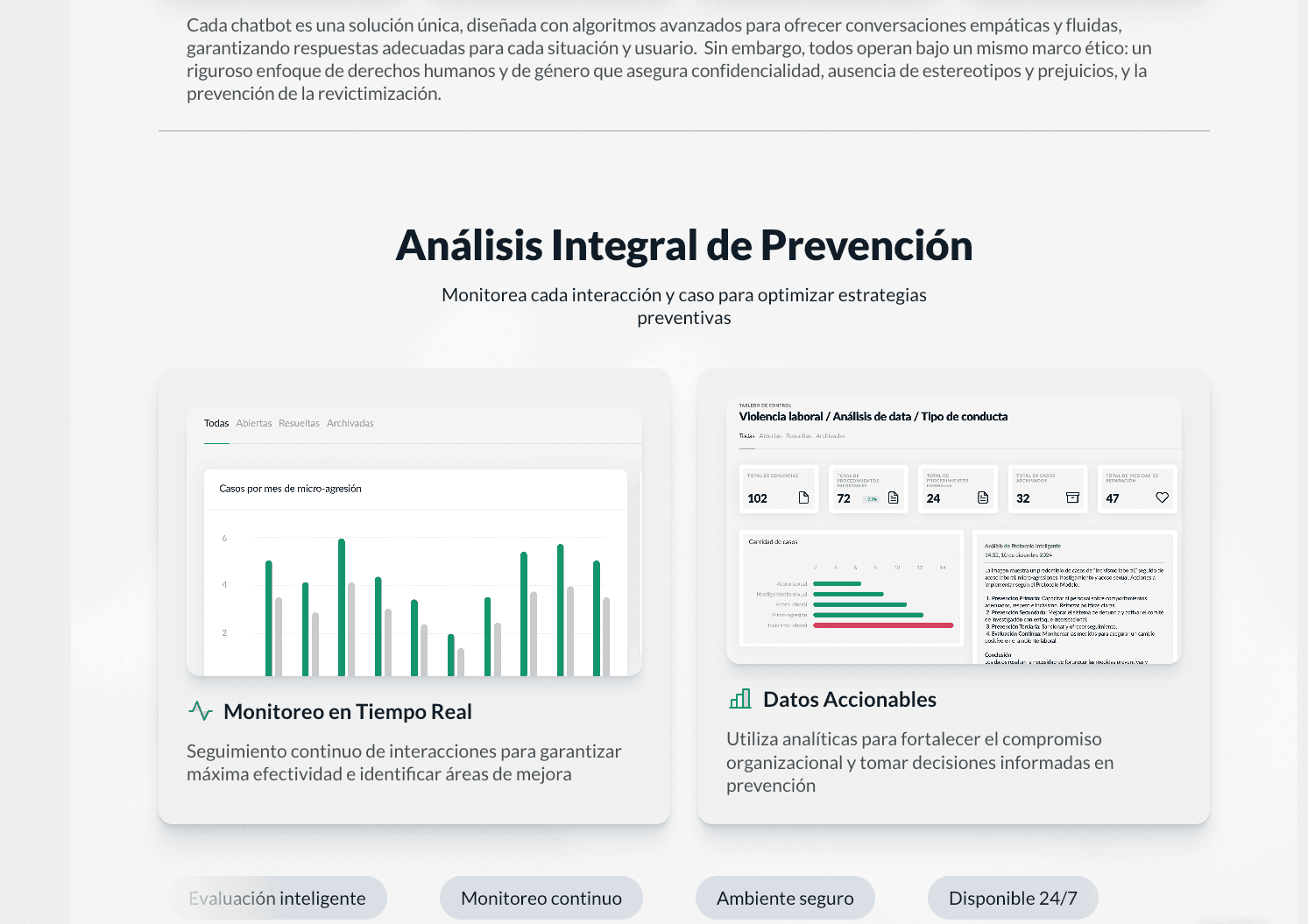
I led the applied-AI design and prototyping across protocol retrieval, hybrid RAG, model experimentation, guided conversational workflows, evaluation, and serving alternatives. The project brought together guided intake, structured case data, protocol-grounded assistance, and prevention analytics without attributing automated decisions to the model.
Two conversations, one prevention system
Understand rights and protocols
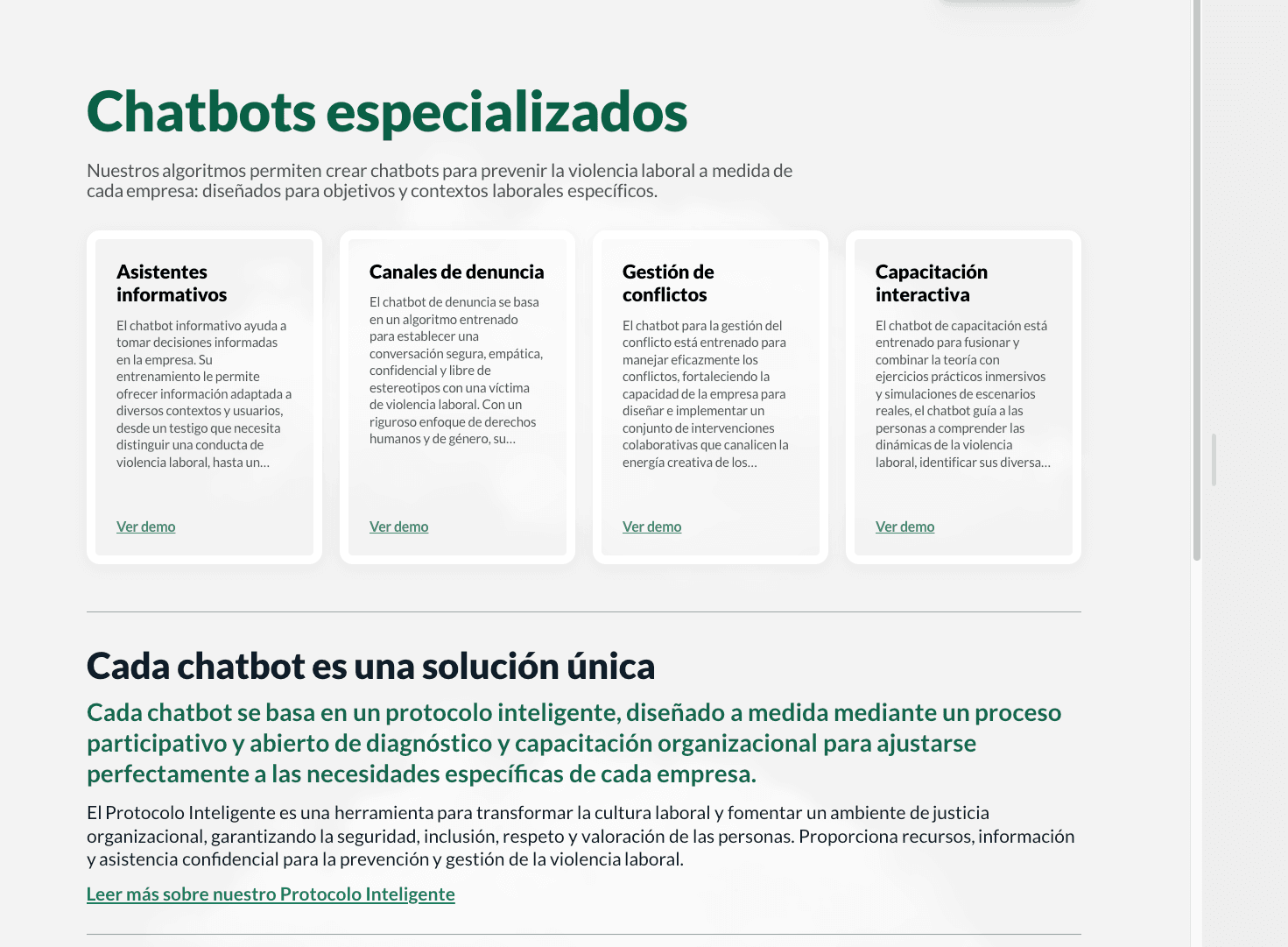
An informational assistant answered questions about workplace violence, prevention, and procedures using curated protocol material. Retrieval kept the source knowledge separate from conversational behavior.
Document an incident
A reporting assistant collected the facts needed for a workplace complaint through conversation, stored them as structured case data, and used the configured protocol to recommend an internal or external escalation path.
Two paths through the product
Simplified architecture
A simplified product view. Each conversation had a distinct purpose and boundary.
Protocol question
A person asks about workplace-safety guidance or a prevention procedure.
Grounded guidance
The assistant explains selected protocol material without making a legal or workplace decision.
Incident account
A guided conversation gathers the facts required by the configured reporting process.
Structured record
The system prepares an authorized record and indicates the appropriate escalation channel.
From an account to a structured report
Start with the person's account
Let the person describe what happened in their own words instead of forcing the experience into a form immediately.
Fill the missing context
Ask focused follow-up questions about location, timing, people involved, witnesses, and the conduct being reported.
Track checklist completeness
Map answers into structured fields in the backend and continue only for information still required by the configured protocol.
Check urgency and severity
Identify indicators of immediate danger or potentially serious conduct while keeping the assistant from making a finding of guilt.
Suggest the next channel
Direct lower-severity workplace concerns toward the internal HR process; for immediate danger or potentially criminal conduct, point to emergency services or the appropriate local authorities.
Create an authorized case record
Persist the structured report for the people responsible for review and aggregate prevention analysis, subject to the organization's access and retention rules.
The live product
From a question to protocol context
Simplified architecture
The retrieval path combines semantic meaning with exact terminology. A model provider consumes the selected context; self-hosted and managed variants are alternative serving paths.
Prepare the query
Expand domain terms while retaining the original question.
Search two ways
FAISS finds semantic matches; BM25 retrieves exact vocabulary and acronyms.
Rerank candidates
A multilingual cross-encoder scores candidate passages against the question.
Restore context
Resolve child matches to larger parent passages, deduplicate, and limit repeated sources.
Apply a relevance gate
Only qualifying retrieved material enters the generation prompt.
Generate a bounded answer
The selected model receives protocol context and instructions for clear Spanish guidance.
Behavior and knowledge need different tools
Behavior: a fine-tuning experiment
The project includes a published QLoRA adapter for Llama 3.3 70B Instruct. Training adjusts a small set of adapter weights while loading the base model in 4-bit form, targeting Spanish workplace-safety conversation patterns. The published artifacts include an adapter and a saved training checkpoint. This establishes the experiment; it does not establish which deployment served it.
Knowledge: retrieval at question time
Protocols remain outside model weights. Hybrid search retrieves relevant passages when a question arrives, so source material can be inspected and updated independently of model training. The application variants use different serving configurations; the adapter is not assumed to be present in every path.
Small matches, enough surrounding context
- Decision
- Search smaller child chunks and return their larger parent passages.
- Rationale
- Precise matching helps locate the relevant passage, while the surrounding protocol often carries definitions, conditions, and next steps needed to interpret it.
- Tradeoff
- Larger context consumes tokens and can repeat information. Deduplication, per-source limits, and a relevance threshold keep that expansion bounded.
- Outcome
- The retrieval pipeline explicitly separates the unit used for matching from the context supplied for generation.
Exploring the serving boundary
Self-hosted inference
A Modal variant loads a quantized Llama model on GPU alongside the API. This offers control over the model runtime and makes GPU allocation and startup behavior part of the application design.
Managed model access
An OpenRouter-backed variant keeps retrieval in the application and calls an allowed model catalog through a provider. This changes the operational tradeoff while preserving the retrieval workflow.
When startup becomes part of the experience
A later variant introduces content-derived snapshots of the retrieval pipeline: chunks, mappings, BM25 state, and the FAISS index. If the corpus and configuration are unchanged, those assets can be restored instead of rebuilt. A changed manifest invalidates the snapshot.
The implementation also records startup timings and includes a cache-warming path. These are mechanisms for reducing repeated startup work; no measured production speedup is claimed here.
What the evaluation can tell us
Stored retrieval tests check whether questions find expected sources and relevant protocol material. They help inspect the retrieval layer, but do not establish the safety or correctness of the complete generated answer.
A useful evaluation separates source selection, passage relevance, response quality, and appropriate referral. Sensitive-domain answers still need human review against those criteria.
A system with distinct improvement paths
The project joined a guided reporting workflow and prevention dashboard with a domain adapter experiment, hybrid retrieval, several model-serving variants, and a snapshot-based startup experiment. Each addressed a different part of the product: collecting a report, organizing case data, selecting evidence, shaping conversational behavior, or delivering the service.
Keeping those concerns separate makes the next iteration specific. A missing report field calls for inspecting the intake state; an unsafe escalation calls for reviewing the protocol rules; a retrieval failure calls for inspecting sources and ranking; a tone problem calls for reviewing instructions or behavior.
What the project makes clear
- Fine-tuning and retrieval address different forms of specialization.
- A conversational report still needs an explicit data model and completion criteria.
- Escalation rules should route a case, not adjudicate it.
- Semantic search and keyword search complement each other when questions contain precise procedural language.
- A good matching passage may still need its surrounding context.
- Retrieval tests are not a substitute for reviewing complete answers.
- Model hosting can change without replacing the knowledge pipeline.